
Highlights:
- Your investment plan should still fit what you want the money for today.
- Big life changes are a good reason to check whether your old plan still makes sense.
- You do not need to change anything just because markets move or the news is scary.
You can be following your investment plan perfectly and still need to change the plan.
Maybe you chose your investments a few years ago and have been steadily adding money ever since.
But a lot can change in a few years.
You might buy a home, have a child, change jobs, start earning more or less, or get much closer to retirement.
Your investments may not have done anything wrong. Your life may have simply changed.


Your portfolio can follow the plan perfectly and still need a rethink
Imagine you decided years ago how you wanted to invest your money.
Since then, you have kept your portfolio close to that plan.
That is what rebalancing helps with. If some investments grow faster than others, your portfolio can slowly move away from the mix you originally chose. Rebalancing means adjusting things so they line up with your plan again.
We explain that process in how to automatically rebalance an ETF portfolio.
But there is another question that is easy to miss:
Is the plan itself still right for you?
Maybe the plan made sense when you created it.
But if what you are saving for, when you need the money, or your financial situation has changed, it is worth looking at again.
You do not need a complicated financial plan to do this.
Start with three things:
- What is the money for?
- When do you expect to need it?
- How would you feel if the value dropped a lot for a while?
These are also some of the basics Canadian investment guidance looks at when deciding whether investments fit someone’s situation. CIRO’s investor suitability guidance looks at things like goals, when the money will be needed, someone’s financial situation, and how much investment loss they can handle.
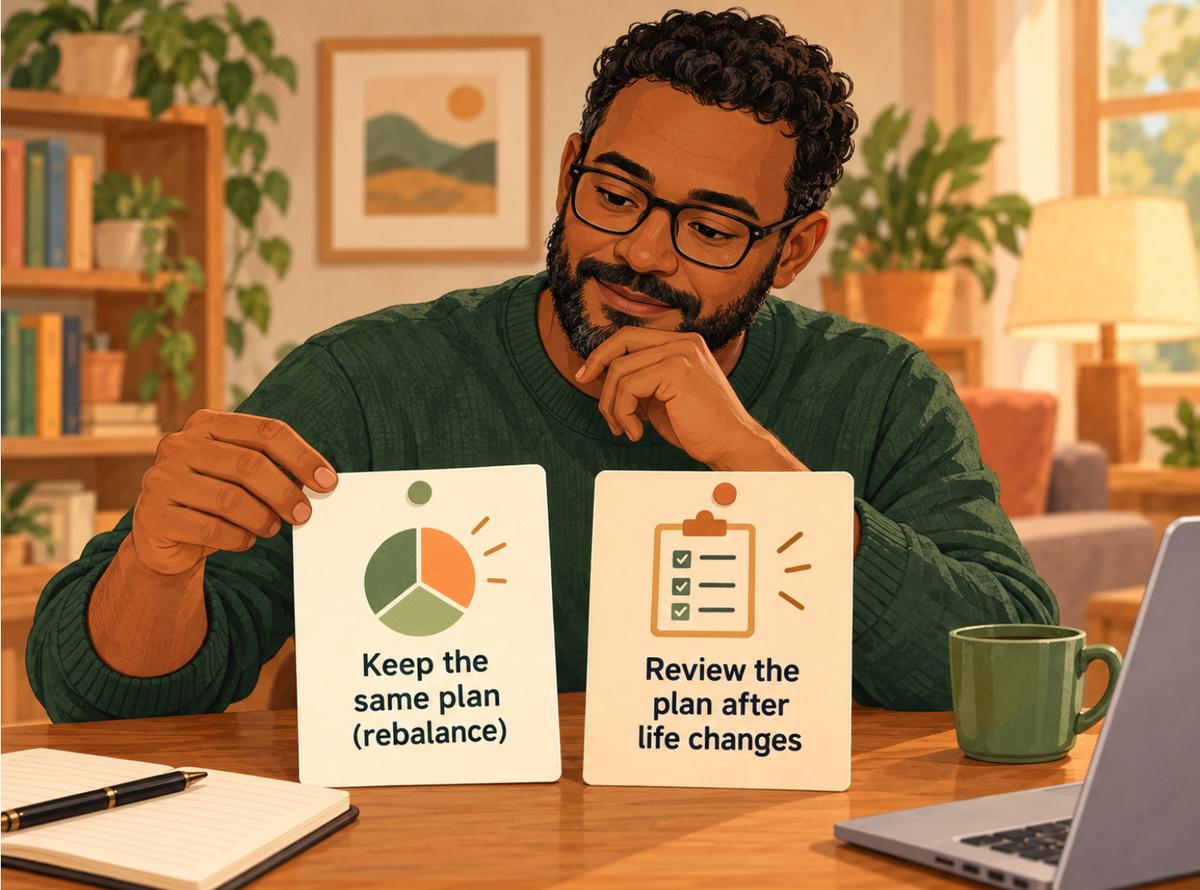
Life changes that are worth checking your investment plan after
A big life change does not automatically mean you should sell your investments or build a new portfolio.
It just means the plan you made before might not fit your life as well anymore.
Here are some good times to take another look.
You are planning to buy a home
Maybe your investments used to be money you would not need for decades.
Now you are thinking about buying a home in three or four years.
That changes the timeline for any money you plan to use for the purchase.
Money for retirement 25 years from now and money for a home in three years have very different jobs.
You got married or separated
A relationship change can affect your income, expenses, savings and future plans.
You may also start sharing some financial goals with another person, or separating money that used to be managed together.
That makes it worth checking whether the plan you already have still fits.
You had a child
A child can change your finances in a lot of ways.
You may have higher monthly expenses. You might take parental leave, work fewer hours for a while, or decide you want to save for your child’s education.
You do not necessarily need different investments.
But you do have new things competing for the same money.
Your work or income changed
Maybe you got a big raise.
Maybe you lost a job, became self-employed, changed careers, or decided to work fewer hours.
Any of those can change how much you are comfortable investing and how much money you need to keep available.
CIRO even uses job loss as an example of a significant change that can affect someone’s investment situation.
You are getting closer to needing the money
This one can happen without a dramatic life event.
Maybe retirement used to be 25 years away.
Now it is eight.
Or maybe you started investing for a home without a firm date, and suddenly you are hoping to buy within two years.
The closer you get to needing the money, the less time you have to wait out a large market drop.
You may hear this called your time horizon. It simply means how long you expect to leave the money invested before you need it.
The Ontario Securities Commission’s investor education site also recommends reviewing an investment plan as your goals, timeline and financial situation change. You can read its investment planning guide here.
Five simple questions to ask yourself
You do not need to rebuild your entire portfolio every time something changes.
Start by asking these five questions.
1. What is this money for now?
Maybe the answer is exactly the same as it was five years ago.
That is fine.
But maybe some money that used to be for “the future” now has a specific job, like a home purchase.
Knowing what the money is for makes the rest much easier.
2. When will I need it?
Think in normal dates, not investing terms.
Do you expect to use this money:
- next year?
- in five years?
- in 20 years?
- possibly never, because it is meant for retirement or your family later?
Money you need soon may need to be treated differently from money you can leave invested for decades.
3. Has my financial situation changed?
Look beyond your investment accounts.
Are your monthly expenses much higher?
Has your income changed?
Do you have more debt?
Do you have a bigger emergency fund?
Do other people now depend on your income?
A market drop might have felt manageable when your expenses were low and you had lots of extra cash every month. It may feel very different after your financial responsibilities change.
4. Would I choose this same plan if I were starting today?
This is a useful way to get around the fact that we get attached to what we already own.
Pretend you were starting fresh.
Knowing what you know about your life today, would you choose roughly the same investments?
If the answer is yes, great.
If the answer is no, it is worth understanding why before you make your next contribution.
5. Is all this money still for the same thing?
Sometimes the biggest improvement is not changing investments.
It is separating money that now has different jobs.
Your retirement savings might still be invested for the long term.
Money for a home in a few years might need its own plan.

What this can look like in real life
Imagine you started investing at 30.
You were single, renting, had steady income and were saving for retirement.
You put money into your TFSA and RRSP and chose a simple portfolio you felt comfortable holding for a long time.
Five years later, your life looks different.
You have a partner and a child. You are planning to buy a home. Your monthly expenses are higher, and you expect to use some of your savings much sooner than you originally thought.
Your old portfolio did not suddenly become bad.
It may still make perfect sense for the money that is meant for retirement.
But some of your money now has a different job.
That is the part worth reviewing.
You might decide to keep your retirement money exactly as it is and start treating the home money separately.
You might decide nothing needs to change at all.
Either answer can be reasonable.
The point is to make sure you are still following the plan because it fits your life today, not simply because it is the plan you picked years ago.

A bad week in the market is not a life change
This distinction matters.
Your investment plan should not change every time markets fall or financial headlines get scary.
Markets moving up and down is normal.
If nothing important in your own life has changed, your old plan may still be completely fine.
That is when rebalancing can be useful.
If your plan still makes sense but your investments have moved away from it, you may simply need to bring the portfolio back toward the target you already chose.
Our article Does portfolio rebalancing improve returns? explains why rebalancing is mainly about keeping your investments close to the amount of risk you originally chose.
If reviewing your plan makes you realize you do not want to manage the investments yourself anymore, DIY investing vs robo-advisors explains the main differences.
Keep your plan simple enough that you understand it
You should be able to explain your investment plan without needing a spreadsheet full of formulas.
Something like this is enough:
This money is for retirement. I probably will not need it for another 20 years. I am comfortable with it moving up and down because I have a long time before I need it.
Or:
I am hoping to use this money for a home within three years. I care more about having the money available when I need it than trying to get the highest possible return.
That is much more useful than having a complicated portfolio you cannot explain.
It is also worth doing a quick check even if nothing major has happened. The Ontario Securities Commission’s investor education site suggests reviewing an investment plan about once a year because goals and circumstances can change.
Passiv can help once you know what you want the plan to be.
Your model portfolio in Passiv is simply the investments and percentages you want Passiv to use as your target.
If your life changes and you decide your investment plan should change too, you can update that target.
Passiv then does the calculations based on the plan you chose.

Before your next rebalance, check whether the goal changed
If your life looks different from when you first chose your investments, ask what changed before automatically buying or selling anything.
Has the goal changed?
Do you need the money sooner?
Has your financial situation changed?
Would you still choose the same plan today?
If the answers all point back to the same plan, you may not need to change it at all.
If the plan really has changed, update the target first.
If you have the same goal spread across accounts such as a TFSA and RRSP, Passiv can also manage multiple accounts as one portfolio.
Passiv can help you follow the plan.
You still decide what the plan should be.