
Highlights:
- Start with what the money is for before deciding what belongs in each account.
- See the important differences between a TFSA, RRSP and taxable account at a glance.
- Learn how to manage several investment accounts without treating each one like a separate portfolio.
Should you manage your TFSA, RRSP and taxable account together?
If the accounts are being used for the same goal and roughly the same timeline, it can make sense to manage the investments as one portfolio.
- For example, your TFSA, RRSP and taxable account might all be part of your retirement savings.
- If the money is for different goals, the accounts may need separate plans. A TFSA you expect to use for a home purchase in five years may need to be managed differently from an RRSP you do not expect to touch for another 30 years.
- Start with the goal. Then decide which accounts belong together.


What is the money in each account for?
Before asking what investment should go in your TFSA or RRSP, think about what you eventually want the money to do.
It could be for:
- retirement
- buying a home
- helping your kids later
- creating more financial flexibility
- long-term wealth
- something you expect to spend within the next few years
The timeline matters.
Money you expect to use soon may be invested differently from money you will not need for decades.
Imagine your TFSA and RRSP are both for retirement. You also opened a taxable investment account because you have more long-term money to invest after using the contribution room available to you in your registered accounts.
Those three accounts are different, but the money has the same job.
It can be useful to look at the investments together.
Now imagine your TFSA is money you expect to use for a home purchase in a few years, while your RRSP is meant for retirement.
Those accounts have different jobs and timelines. Combining them into one investment plan may make less sense.
What is the difference between a TFSA, RRSP and taxable account?
Once you know what the money is for, account type becomes important.
Here is the basic difference:

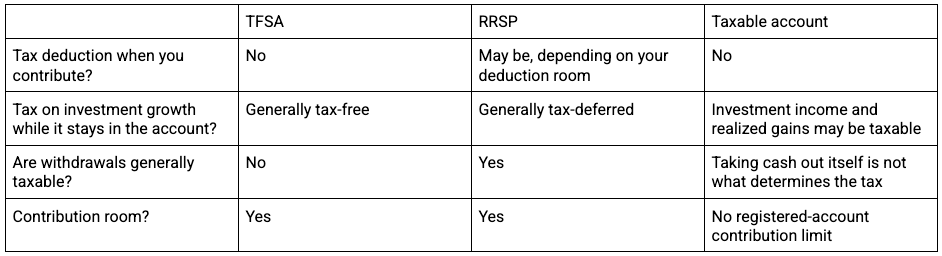
TFSA
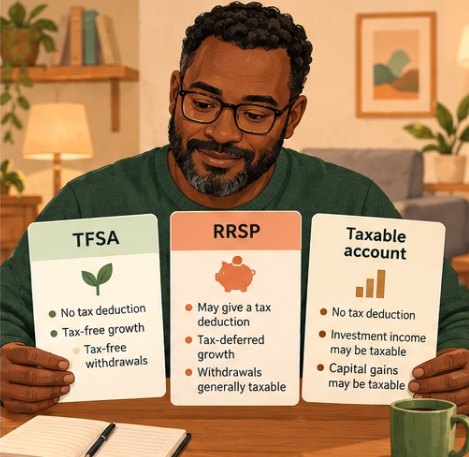
A TFSA does not give you a tax deduction when you contribute.
Investment income and gains inside the account are generally tax-free, and withdrawals are generally tax-free too.
The TFSA dollar limit for 2026 is $7,000, but that does not mean everyone can contribute $7,000 right now.
Your personal contribution room depends on things like your age, Canadian residency, unused room, previous contributions and previous withdrawals.
The CRA recommends keeping your own records when calculating your available room. You can see the CRA’s current TFSA contribution-room rules.
RRSP
RRSP contributions may reduce your taxable income, depending on your available RRSP deduction room.
The 2026 RRSP dollar limit is $33,810, but again, that is not automatically how much you personally can contribute.
Your deduction room depends on your income, unused room and pension-related adjustments, among other factors.
Money in an RRSP generally grows tax-deferred while it stays inside the plan. Withdrawals are generally taxable.
The CRA explains how your RRSP deduction limit is calculated.
Taxable account
A taxable account is also called a non-registered account.
It does not have the same tax shelter as a TFSA or RRSP.
Depending on what you own, you may need to report investment income such as interest and taxable Canadian dividends. Selling investments can also create capital gains or losses that need to be reported.
The CRA has an overview of investment income and how it is reported.

Should your TFSA and RRSP hold the same investments?
They do not have to.
If several accounts are working toward the same goal, what matters is what you own across those accounts together.
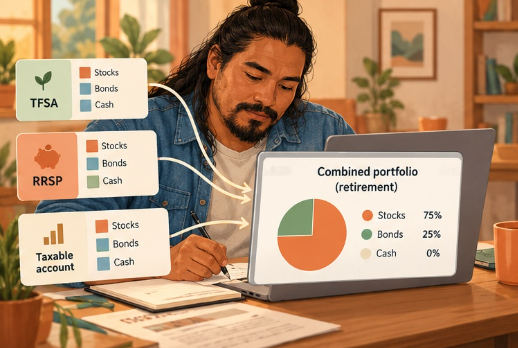
Suppose your TFSA, RRSP and taxable account are all being used for retirement.
Your TFSA might hold stock ETFs.
Your RRSP might hold a mix of stock and bond ETFs.
Your taxable account might hold another part of the portfolio.
You do not need to make every account look identical.
Instead, ask whether the combined investments match the plan you chose for your retirement money.
That can make a multi-account portfolio much easier to understand.
You are no longer trying to build three perfect little portfolios. You are building one retirement portfolio that happens to live in three accounts.
If some of your accounts have completely different goals, keep those plans separate.
Passiv lets you group multiple accounts into one portfolio when they belong together, while keeping accounts with different goals separate.
How do you manage investments across multiple accounts?
You do not need to start with a complicated spreadsheet.
Try this.
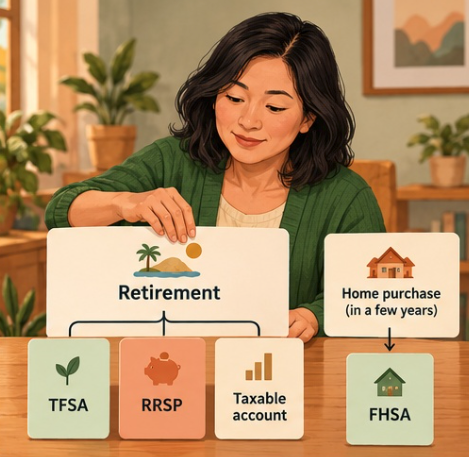
1. Group your accounts by goal
Write down what each account is for.
For example:
Retirement
RRSP
TFSA
taxable account
Home purchase
- FHSA
- a different TFSA
Only combine the accounts that are genuinely working toward the same thing.
2. Look at what you own across those accounts
Write down each investment and its current value.
If you have retirement investments at two different brokerages, include both.
You are trying to see the whole retirement portfolio, not just what appears on one brokerage screen.
3. Group similar investments together
For a beginner, broad categories can be enough.
You might start with:
- stocks
- bonds
- cash
If your portfolio is more complicated, you can break those categories down further later.
4. Look at the combined mix
Imagine you have $100,000 invested for retirement across your TFSA, RRSP and taxable account.
When you add everything together, you discover you have:
- $75,000 in stocks
- $25,000 in bonds
Your combined retirement portfolio is therefore 75% stocks and 25% bonds.
You can compare that with the investment mix you decided was right for your goal.
The individual accounts still do not need to have the same percentages.
5. Check whether anything needs to change
Markets move at different speeds.
Over time, the investments you own can move away from the mix you originally chose. This is called portfolio drift.
Rebalancing means bringing the portfolio back toward your target.
If you want to understand that process in more detail, read our guide to rebalancing an ETF portfolio step by step.

How do you know where your next contribution should go?
Once you can see the whole portfolio, deciding what to do with new money becomes easier.
Imagine your retirement plan calls for a mix of stocks and bonds.
You check all your retirement accounts together and find that stocks now make up more of the portfolio than you intended.
Instead of automatically buying more stocks with your next contribution, you could direct that contribution toward the part of the portfolio that is underweight.
That can help move the portfolio back toward your target without immediately selling an investment.
You still need to decide which account should receive the contribution.
Check your available contribution room before putting new money into a TFSA or RRSP.
And before selling an investment in a taxable account, remember that the sale can have tax consequences.
The portfolio can be managed together while the rules of each account still apply separately.
How do you keep several investment accounts organized?
Doing this exercise once is manageable.
Repeating it is the annoying part.
Your TFSA changes in value. You contribute to your RRSP. A dividend arrives in another account. Markets move again.
A few months later, the numbers you wrote down are already out of date.
This is where having one view of your accounts becomes useful.
Passiv lets you connect multiple investment accounts and group the ones that belong to the same portfolio.
You can also create a model portfolio, which tells Passiv which investments you want to hold and the percentages you are aiming for.
Passiv then compares what you currently own with that target and does the calculations for you.
The current Passiv Community plan is $0 per month and includes automated calculations and multi-account portfolios.

If you are still figuring out whether you want to manage your investments yourself, our guide to DIY investing vs robo-advisors explains the differences.
Start with the goal, then choose the accounts
You do not need to know the perfect investment for every account before you can get organized.
Start with what the money is for.
Then ask:
- Which accounts are working toward that goal?
- When will I need the money?
- What investments do I own across those accounts?
- Does the combined portfolio still match my plan?
- Where would my next contribution be most useful?
That gives you a much clearer starting point than trying to optimize every TFSA, RRSP and taxable account separately.
Want an easier way to manage investment accounts that are working toward the same goal?
Passiv’s free plan lets you bring multiple accounts together, compare your investments with the portfolio you want, and have the calculations done for you.