
Highlights:
- Your portfolio doesn’t stay the mix you picked. See what it turns into.
- What that slow shift could cost a $300,000 portfolio in a single bad year.
- Since 1926 there have been seven moments when rebalancing really mattered, and every one felt like the wrong time to do it.
Some people choose to hold 80% stocks. Others end up there by accident.
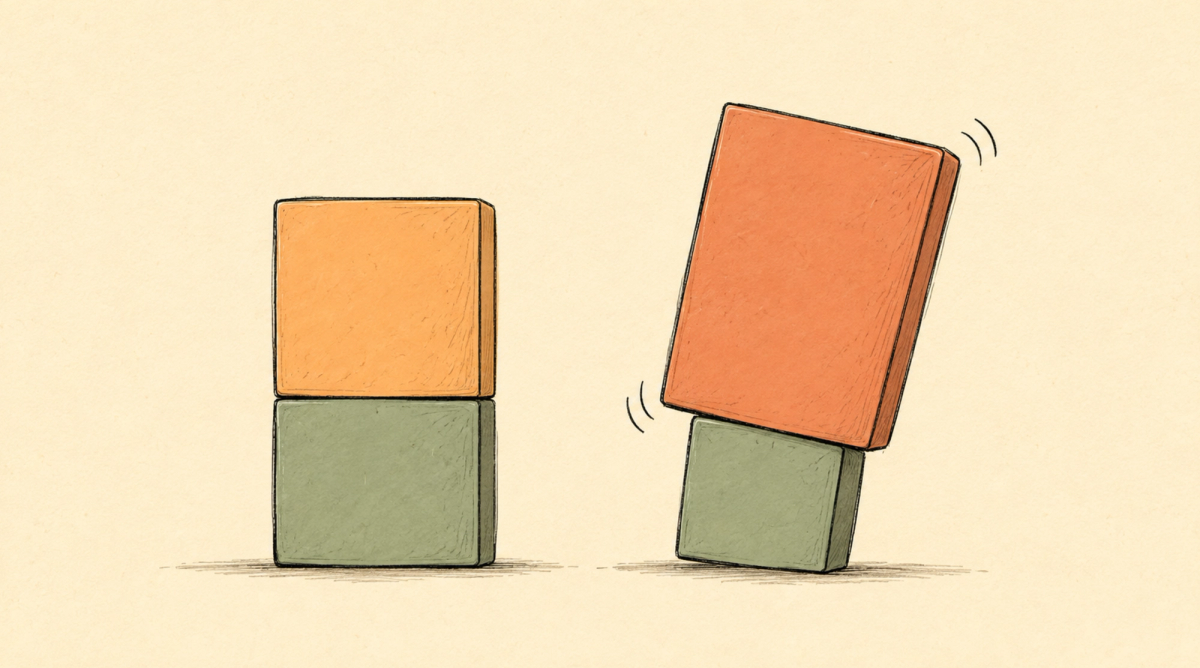
It happens slowly enough that nobody notices. The growth side of a portfolio tends to outrun the safer side over long stretches, so its share creeps up year after year. Nothing feels different, because nothing bad has happened yet.
That slow slide away from the mix you picked has a name. It’s called drift, and rebalancing is what undoes it. Whether rebalancing also makes you money is a separate question, and the answer is more interesting than the usual advice suggests.


The short answer
Rebalancing is not a dependable way to make more money. It’s a way to keep your portfolio close to the risk level you chose.
That’s a smaller promise than most rebalancing advice makes. It’s also the one the research supports.
What the returns data actually shows
Two separate studies, different continents, different decades, same conclusion.
Vanguard’s investment strategy group took a portfolio built to sit at 60% stocks and 40% bonds, and ran it through U.S. market data from 1926 to 2009, published in the AAII Journal. Rebalanced once a year, it returned 8.6% annually. Never rebalanced at all, it returned 9.1%.
Yes, the untouched version made more money. It also stopped being the portfolio it started as. Set at 60% stocks on day one, it drifted to an average of more than 84% stocks over the period, because nobody ever pulled it back. That slide of at least 24 points is where the extra return came from, and it’s the part that doesn’t show up until a bad year.
justETF ran a similar test on European data from 2003 to 2022, using global stocks and German government bonds. Their 60/40 earned 6.3% a year without rebalancing and 6.1% with it. Rebalancing cost about two tenths of a percentage point.
Here’s what stops this from being a clean verdict. justETF also found that over 2001 to 2020, the same 60/40 portfolio came out ahead by about half a percentage point for rebalancing. Move the window two years and the answer flips sign.
That’s the real finding. Rebalancing’s effect on returns depends on which stretch of history you happen to live through, which makes it something you can’t plan around. Dan Bortolotti at Canadian Couch Potato lands in the same place: rebalancing is mostly risk management, and higher returns, when they show up, are a bonus rather than the reason.
The number that matters more
Now look at what those same portfolios did in a bad year.
In the justETF simulation, across eleven different stock and bond mixes:
- 100% stocks: 8.0% a year, worst year down 35.4%
- 80% stocks, 20% bonds: 7.1% a year, worst year down 26.6%
- 60% stocks, 40% bonds: 6.1% a year, worst year down 17.4%
Now put those worst years in dollars. Say you have $300,000 invested:
- At 60% stocks, the worst year cost about $52,000
- At 80% stocks, about $80,000
- At 100% stocks, about $106,000
On a $300,000 balance, the gap between the 60/40 and 80/20 examples is about $28,000 in their worst year. That’s the kind of difference drift can create if your portfolio becomes much more stock-heavy before a downturn.
And that’s the gentle version. The Vanguard portfolio started at 60% stocks and drifted past 84%, further than any of the examples above.
Now, an important thing to be clear about. Rebalancing does not stop you from losing money. The portfolio rebalanced back to 60/40 every year still had a year where it dropped 17.4%. Nothing prevents that.
What rebalancing does is keep your exposure closer to the risk level you chose.
That sounds like a small difference. It isn’t. If you built a portfolio understanding it could fall meaningfully in a bad year, a bad year is unpleasant but it’s the deal you made. If your portfolio has drifted well past the mix you picked, the drop arrives bigger than anything you had in mind, and you start wondering whether you understood any of this. That’s usually when people sell at the bottom. A drop you were prepared for is something you sit through. A drop that blindsides you is something you react to.
Worth saying plainly: these are historical figures from one 20-year sample. They show what happened, not a limit on what can happen. justETF is explicit that past returns don’t predict the next period, and future declines could be milder or considerably worse.
What if you hold all stocks on purpose?
Plenty of investors do, and none of the above is an argument against it.
If you looked at historical drops like the 35% year in this sample, decided you can live through losses on that scale or worse, and built a portfolio to match, you’ve done the thing this whole article is about. You know what you’re holding and you chose to hold it. The return that comes with it is yours.
The problem is only ever the gap between the risk you picked and the risk you’ve got.
Which is worth spelling out, because the fix looks different depending on how you invest:
If you hold a single all-in-one ETF, there’s nothing for you to rebalance. These funds hold several underlying ETFs and are continually monitored and rebalanced by the manager to keep the target weights. That’s the whole appeal, and for a lot of people it’s the right call.
The tradeoff is flexibility. You can’t change the mix inside the fund. If you want more bonds or less Canada, you’d need to switch funds or add other holdings, and selling in a non-registered account can create a tax bill. All-in-one ETFs can also have slightly higher fund costs than building similar exposure yourself, but the fees aren’t simply stacked on top of the underlying ETFs.
If you hold several ETFs yourself, you’ve kept the control, and rebalancing is the price. It applies whether or not you own any bonds. An all-stock portfolio built from separate Canadian, U.S. and international funds drifts the same way. Whichever region has run hardest becomes a larger slice than you intended, and you can end up more concentrated in one market than you meant to be.
And if you hold a mix of both, an all-in-one fund alongside individual holdings, this is where people most often lose track of their real numbers. The one-ticket fund already contains its own internal mix, so you can’t work out your true exposure by reading ticker names alone.
That’s the actual trade. Hand someone else the wheel, or keep the wheel and do the work. Doing the work is only a problem when it’s more work than it needs to be.

More often isn’t necessarily better. Doing it at all matters more.
Here the research is unusually clear.
The Vanguard study found no optimal frequency and no optimal threshold. Risk-adjusted returns weren’t meaningfully different whether the portfolio was rebalanced monthly, quarterly, or annually. What changed was the workload. One version, checked monthly with a tight 1% trigger, needed 389 rebalancing events. Another, checked yearly with a 10% trigger, needed 15. Far more rebalancing events and turnover, without much difference in the risk-and-return results.
Their recommendation for most broadly diversified stock and bond portfolios: check annually or twice a year, rebalance at a 5% threshold, and lean toward annual when taxes or your own time come into it. They do note that more concentrated or aggressive portfolios can behave differently and may need closer attention. Bortolotti’s version for Canadians is blunter. The academic work on timing is inconclusive, so once a year is fine for most people.
One more detail from the Vanguard work is worth sitting with. Since 1926, using a 60/40 with annual rebalancing at a 5% threshold, meaningful chances to rebalance into stocks after a badly negative market arrived seven times: 1930, 1931, 1937, 1974, 2000, 2002 and 2008.
Seven times in eighty-four years. Every one of those dates was a moment when buying more stocks felt like the worst idea available. The researchers say as much. Poor performance combined with real uncertainty made it feel counterintuitive to sell what was working and buy what wasn’t.
That’s the whole discipline. Boring for years, then it asks something hard of you once a decade.

The easiest rebalance is the one where you don’t sell anything
Timing isn’t what separates a cheap rebalance from an expensive one. Taxes and trading are.
Selling an investment that’s gained inside a non-registered account can create a reportable capital gain. Trading a qualified investment inside a TFSA or RRSP doesn’t trigger a capital gain at the time of that trade, though RRSP withdrawals are generally taxable later. So which account you rebalance in matters more than which month you pick.
Which points at the easiest version of all: don’t sell anything.
Every contribution is a chance to rebalance. Instead of splitting new money across your holdings the way you usually do, send it to whatever is running low. Do that consistently and your portfolio walks back toward its target on its own. No selling, no realized capital gain from the rebalance, and fewer trades.
The Vanguard researchers tested exactly this. An investor who simply redirected their portfolio’s income to whatever was underweight captured most of the risk-control benefit of the trade-heavy strategies, at far lower cost.
If you contribute regularly, this may handle most of your rebalancing. After a large market move, new money might not be enough on its own, and you may still need to sell something that’s run ahead.
The only hard part is the math. Buying what you’re short of means first knowing your real split across every account, then working out how many shares of which fund that translates into. It’s not complicated. It’s just the thing people don’t feel like doing on a Tuesday night.
That’s the part Passiv takes over. Set your target mix once, and when cash lands it works out what to buy to move you back toward it. The free account does the calculations and shows you the trades, and you place them in your brokerage yourself. On Elite, you place them all in one click without leaving Passiv.
So the routine is short. Pick a mix you can live with in a bad year, not a good one. Look at it once or twice a year. Send new money wherever you’re short. Sell only when new money can’t close the gap, and check the account first. Don’t chase the decimal.
If you want the mechanics step by step, we walked through them in how to rebalance a portfolio.
Want to make rebalancing easy?
Passiv’s Forever Free account does the math for you, tells you when your portfolio has drifted, and tracks everything across your accounts, all without paying a cent. Set up your target portfolio in about 10 minutes.